
CHEA President Nasser H. Paydar: The Ultimate Goal of Quality Assurance in the Age of Artificial Intelligence is Trust
- Date 22 September 2026
CHEA President Nasser H. Paydar: The Ultimate Goal of Quality Assurance in the Age of Artificial Intelligence is Trust
Council for Higher Education Accreditation (CHEA) President Dr Nasser H. Paydar stated that in the age of artificial intelligence, quality assurance must focus not only on whether institutions use artificial intelligence, but also on how they manage this technology, noting that human judgment, transparency, fairness, data management, and accountability will be among the key quality indicators of the new era.
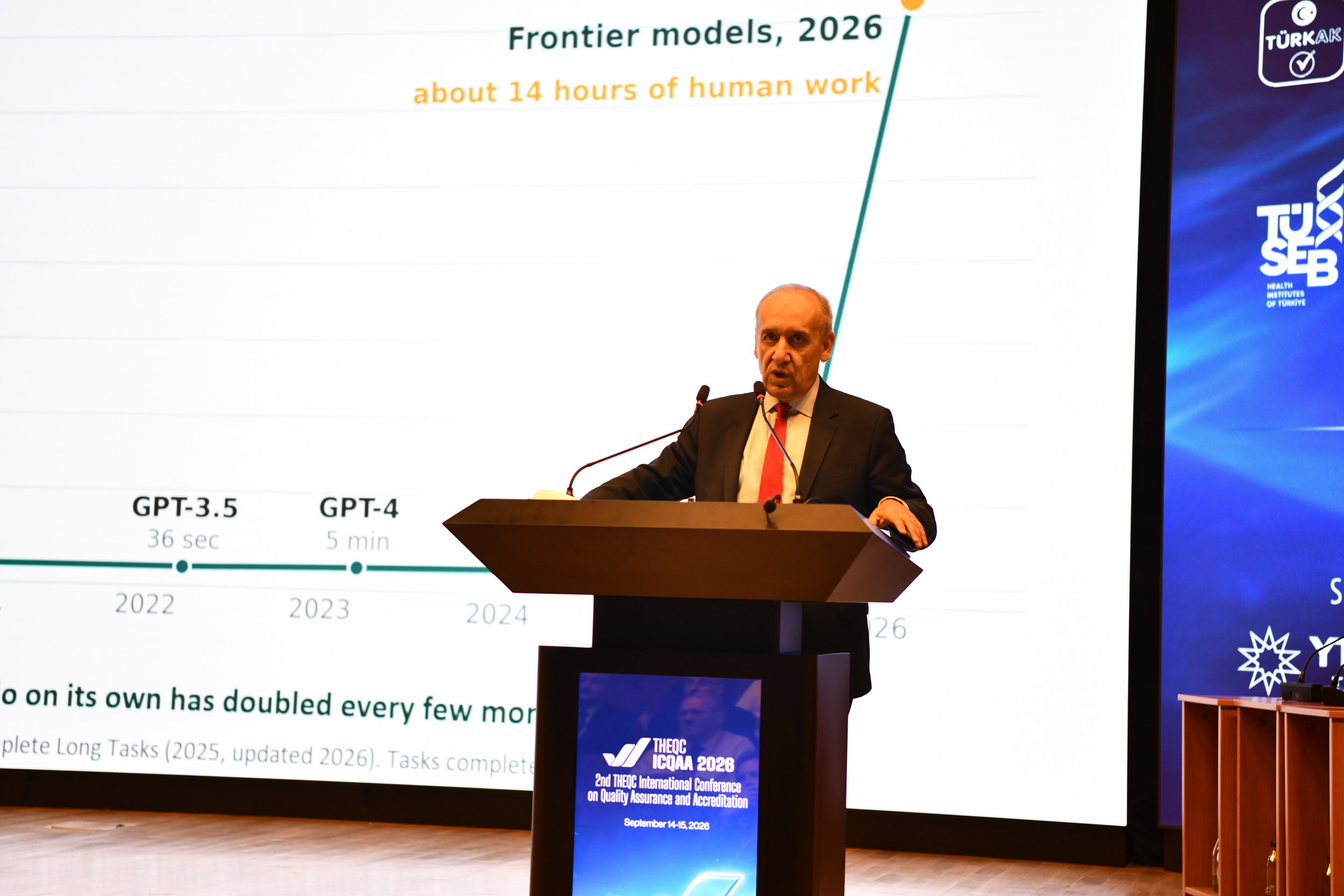
Within the scope of the 2nd THEQC International Conference on Quality Assurance and Accreditation (THEQC ICQAA’26) organised by the Turkish Higher Education Quality Council (THEQC), Paydar delivered his keynote speech titled “Trust in the Era of Artificial Intelligence: The Future of Quality Assurance in Higher Education.”
Stating that humanity has now entered the “age of intelligence” following the industrial and information ages, Paydar said that artificial intelligence has become a transformative technology that strengthens human mental capacity and increasingly goes beyond being just a thinking partner to perform independent tasks. Stating that whether artificial intelligence will be used in higher education is no longer the fundamental question, Paydar emphasised that the real issue is how this technology will be managed.
Drawing attention to the fact that artificial intelligence enters almost every area of universities, from teaching and learning to student advising, admissions processes, research, administrative activities, and the preparation of accreditation documents, Paydar stated that this transformation makes it necessary to rethink the methods, evidence, and standards of quality assurance systems.
Human judgment retains its importance in quality assurance
Paydar stated that in the age of artificial intelligence, quality assurance must evaluate not only whether institutions use artificial intelligence, but how they manage this technology. In this context, he stated that human judgment, transparency, fairness, data management, and accountability will gain greater importance in quality assurance.
Expressing that periodic evaluations in quality assurance must be supported by continuous evidence, Paydar said that up-to-date data can be utilised in areas such as student learning, graduation rates, employment, student involvement, equity indicators, faculty workload, financial sustainability, and student retention.
At the same time, emphasising that predictive indicators should never turn into automated decision-making mechanisms, Paydar pointed out that the results obtained from these indicators should initiate human review, but should not replace human judgment.
The nature of learning evidence is changing
Stating that the ways in which student learning is evidenced must also change in the age of artificial intelligence, Paydar expressed that alongside traditional assignments and exams, the importance of learning evidence such as performance in real-world settings, the ability to apply knowledge and reasoning, original production, internships, capstone projects, simulations, and research is increasing.
Paydar pointed out that in the assessment of learning, not only what students know, but also how they use knowledge and apply it in real-world settings must be taken into account.
Five core principles for artificial intelligence governance
Setting out five core principles regarding artificial intelligence governance, Paydar listed them as the priority of human judgment, verifiability and integrity of materials, security and data protection, transparency in artificial intelligence use, and open boundaries in peer review.
Emphasising that quality assurance agencies must also apply the standards they expect from institutions in their own use of artificial intelligence, Paydar stated that the trust-building function of quality assurance will gain even greater importance in the age of artificial intelligence.
Paydar expressed that with the transition from the information age to the age of intelligence, quality assurance must transform from periodic evaluation to continuous evidence, from compliance to continuous improvement, from institutional oversight to artificial intelligence governance, and from assumed trust to proven trust.
Stating that artificial intelligence will transform higher education, Paydar said that quality assurance will assume a decisive role in building society’s trust in this transformation.
