
ENQA President Ghițulică: Trust and Quality Culture Form the Foundation of Quality Assurance
- Date 22 September 2026
ENQA President Ghițulică: Trust and Quality Culture Form the Foundation of Quality Assurance
European Association for Quality Assurance in Higher Education (ENQA) President Prof. Daniela Cristina Ghițulică stated that quality assurance should support the development of a quality culture in higher education institutions in addition to building trust, noting that quality assurance relies on two core pillars: assurance and enhancement.
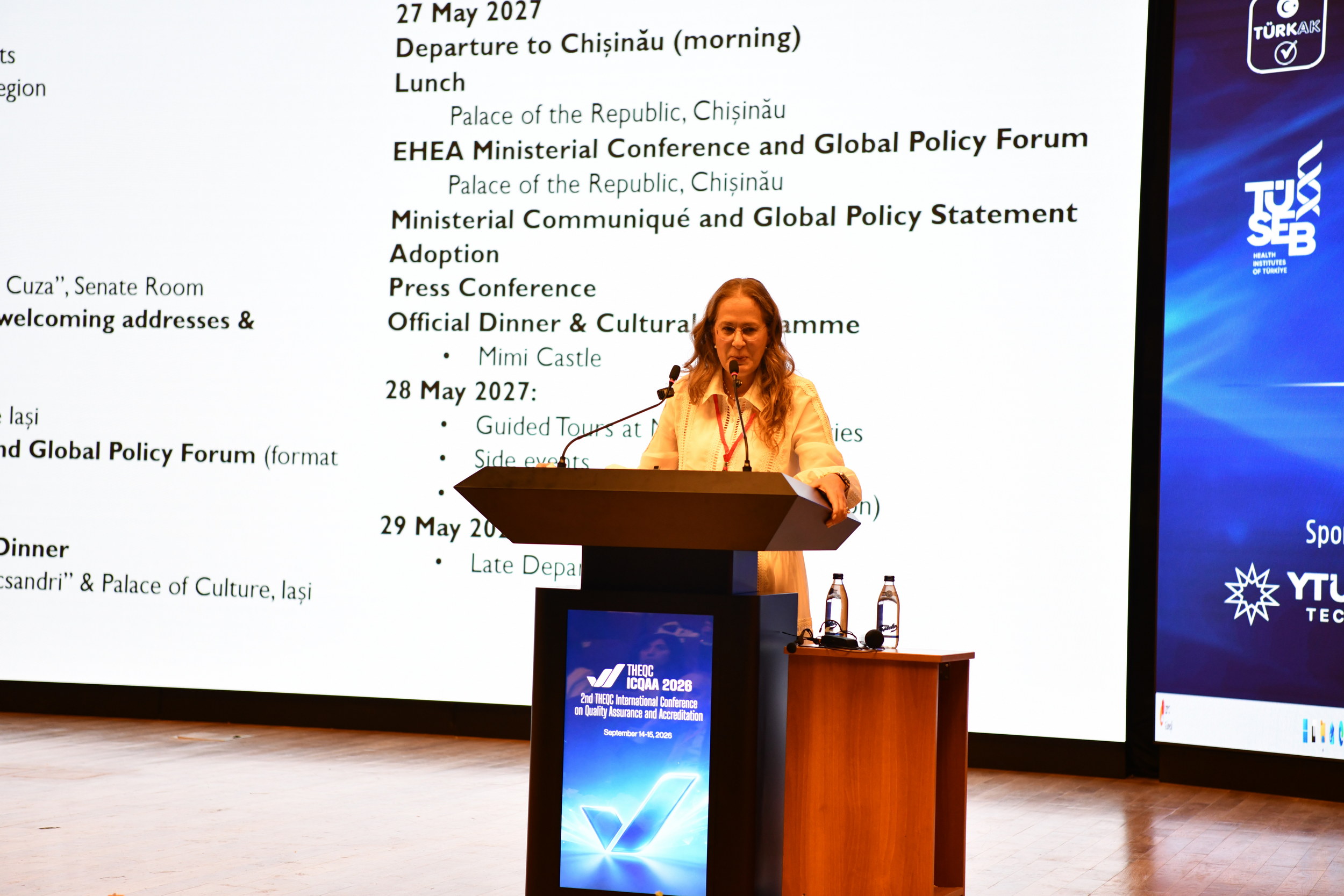
Within the scope of the 2nd THEQC International Conference on Quality Assurance and Accreditation (THEQC ICQAA’26) organised by the Turkish Higher Education Quality Council (THEQC), Ghițulică delivered a speech titled “Quality Assurance in the European Higher Education Area – Framework, Principles and Latest Developments.” In her speech, she discussed the historical development, core principles, and future-oriented current developments of quality assurance in the European Higher Education Area.
Evaluating the role of quality assurance in the transformation of the European higher education system from the perspective of the Bologna Process, Ghițulică reminded that quality assurance has been one of the core fields of work since the beginning of the process. She emphasised that quality is a fundamental element in the European Higher Education Area in terms of trust, mobility, compatibility, and the attractiveness of higher education.
European quality assurance architecture has evolved
Discussing the development of the quality assurance architecture of the European Higher Education Area in her speech, Ghițulică stated that milestones of this process include the establishment of ENQA, the adoption and updating of the Standards and Guidelines for Quality Assurance in the European Higher Education Area (ESG), the establishment of the European Quality Assurance Register for Higher Education (EQAR), and the development of the European approach for quality assurance of joint programs.
Ghițulică drew attention to the fact that the ESG does not impose a single-model quality approach on different higher education systems in Europe. Stating that higher education institutions are primarily responsible for the quality of the education they offer and its assurance, Ghițulică expressed that quality assurance must respond to the diversity of institutions, programs, and students, support the development of a quality culture, and take into account the expectations of students and other stakeholders.
Artificial intelligence is on the agenda of quality assurance
Talking about current developments in Europe, Ghițulică listed upcoming key agenda items as the transition from program-level to institutional-level quality assurance, strengthening the balance between accountability and quality enhancement, online and blended learning, flexible learning paths and QA of micro-credentials, cross-border education and joint programs, and the impact of artificial intelligence on quality assurance.
Also mentioning the preparations for the EHEA Ministerial Conference to be held in 2027, Ghițulică conveyed that the revised version of the ESG and the updating of the European approach for the quality assurance of joint programs are on the agenda.
Quality culture relies on assurance and enhancement
Emphasising the importance of quality culture, Ghițulică stated that quality does not emerge spontaneously, noting that it requires design, co-production, commitment, consistency, and continuous evaluation.
Emphasising that quality culture relies on two core pillars, namely assurance and enhancement, Ghițulică expressed that assurance builds trust, while enhancement moves institutions further forward.
