
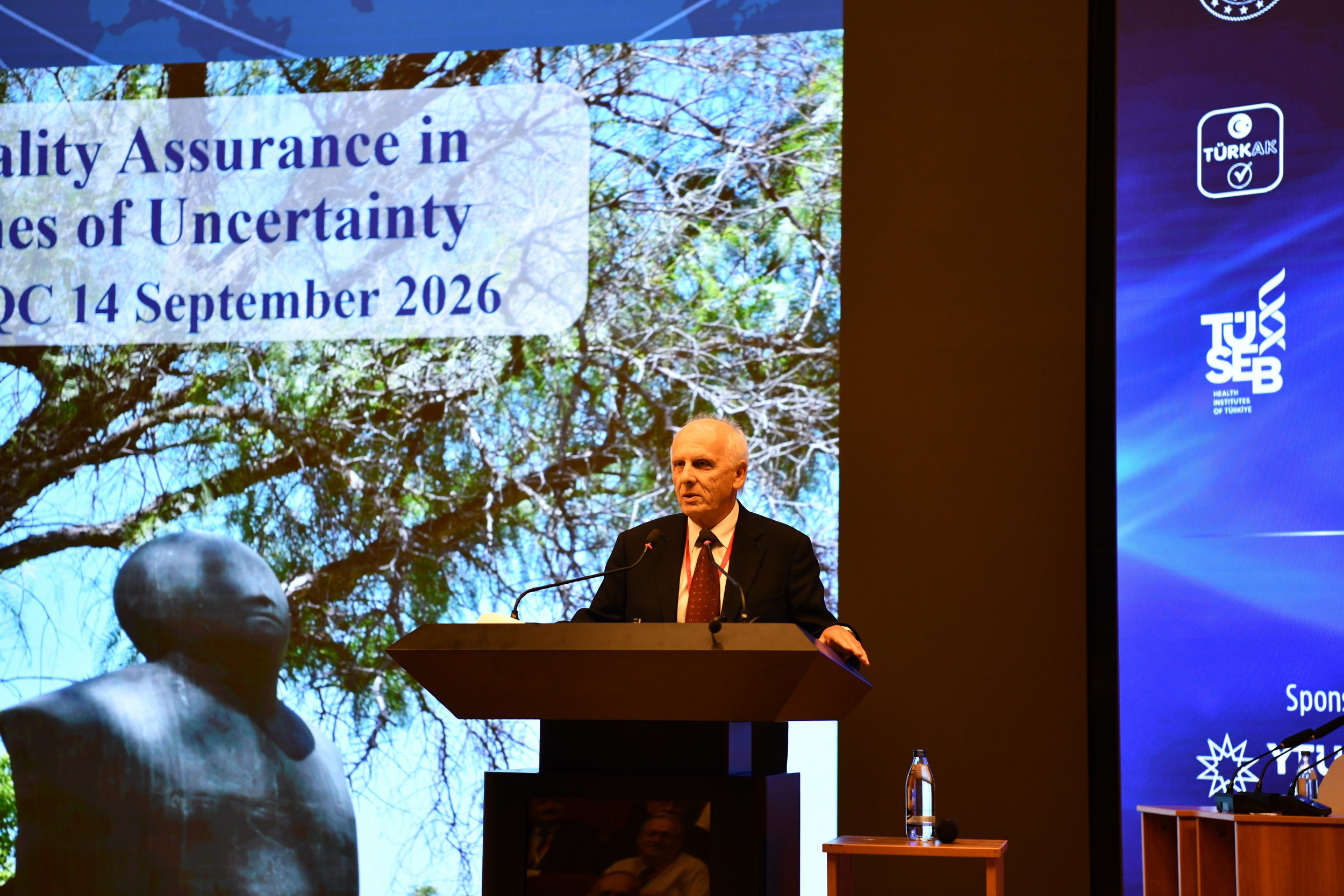
Jamil Salmi: Quality Assurance Should Strengthen Institutional Resilience in Times of Uncertainty
- Date 22 September 2026
Jamil Salmi: Quality Assurance Should Strengthen Institutional Resilience in Times of Uncertainty
Renowned higher education expert Prof. Jamil Salmi emphasised that quality assurance in times of uncertainty should not be treated merely as a mechanism checking whether standards are met, stating that it would be more appropriate for it to also support higher education institutions’ capacity to adapt to change and build resilience against crises.
Within the scope of the 2nd THEQC International Conference on Quality Assurance and Accreditation (THEQC ICQAA’26) organised by the Turkish Higher Education Quality Council (THEQC), Salmi delivered his keynote speech titled “Quality Assurance in Times of Uncertainty.” In his speech, Salmi discussed how higher education systems can be made more resilient against global uncertainties.
Placing trust and resilience at the centre of his speech, Salmi pointed out that higher education is facing numerous simultaneous challenges such as economic and financial fluctuations, climate change, technological transformation, and social tensions. Salmi emphasised that under these conditions, quality assurance must undertake a broader function that supports institutions’ capacity to adapt to change.
Artificial intelligence presents new opportunities and questions
Addressing the transformation brought by artificial intelligence in learning and assessment processes, Salmi stated that technology can be a disruptive, threatening, or developmental element for higher education.
Stating that artificial intelligence offers significant opportunities such as rapid access to information, feedback, and learning support, Salmi noted that it simultaneously brings new questions regarding reasoning, critical thinking, creativity, academic integrity, and assessment processes.
Noting that innovative educational models must be developed to strengthen the resilience of higher education institutions in times of uncertainty, Salmi listed key elements here as focusing on results and outputs, transitioning from quality assurance to quality enhancement, adopting a quality mindset that goes beyond academic excellence, and integrating risk analysis and mitigation processes.
Quality assurance must support innovation
Drawing attention to the importance of student-centred, active, interactive, and experiential learning approaches, Salmi stated that quality assurance systems should recognise and encourage innovation in education rather than merely controlling it.
Expressing that quality should not be evaluated solely through inputs or modes of educational delivery, Salmi emphasised the importance of taking student-acquired learning outcomes and competencies, employment outcomes, ethical values, and social contribution into consideration in quality assessments.
Stating that quality enhancement must be treated at the same level as quality control, Salmi evaluated establishing robust internal quality assurance systems, sharing good practices, regularly monitoring international trends, and guiding institutions on the opportunities and risks of artificial intelligence as important duties of quality assurance agencies in the new period.
Quality mindset must go beyond academic excellence
Stating that the quality mindset in higher education should not remain limited to academic excellence, Salmi expressed that equality and inclusiveness, commitment to scientific evidence, and social responsibility should also be among the core elements of a quality culture.
Drawing attention to the importance of pre-evaluating economic, political, environmental, and health crises that may arise in the future, Salmi listed monitoring new professions to be brought by digital, green, and blue transformations, receiving continuous feedback, and developing rapid decision-making capacity as key elements of institutional resilience.
Trust is one of the fundamental elements of resilience
Concluding his speech with the concept of trust, Salmi stated that quality assurance must be strengthened on the basis of intellectual and institutional independence, flexibility, rapid responsiveness, collaboration, and stakeholder involvement. Emphasising that trust is strong yet fragile, Salmi underlined that trust must be built upon accuracy, transparency, shared values, and mutual respect.
