
EQAR President Stensaker: Digital Transformation Is Reshaping Quality Assurance
- Date 22 September 2026
EQAR President Stensaker: Digital Transformation Is Reshaping Quality Assurance
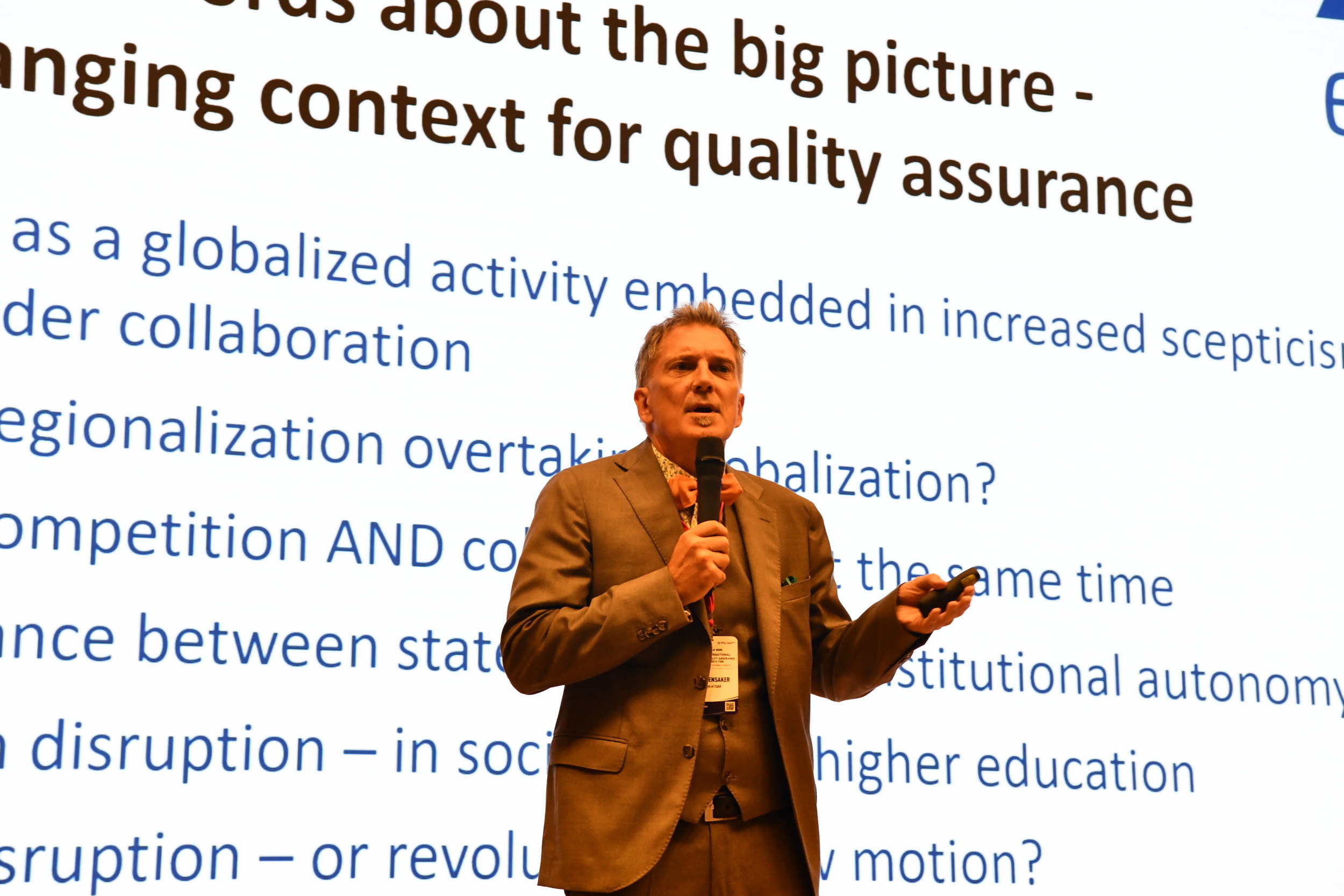
European Quality Assurance Register for Higher Education (EQAR) President Prof. Björn Stensaker stated that digital transformation reshapes quality assurance in higher education not only in terms of technological tools, but also regarding what is evaluated, how evaluations are conducted, and how the social legitimacy of quality assurance is established.
Within the scope of the 2nd THEQC International Conference on Quality Assurance and Accreditation (THEQC ICQAA’26) organised by the Turkish Higher Education Quality Council (THEQC) on 14-15 September 2026, at Yıldız Technical University Davutpaşa Campus, Stensaker delivered a keynote speech titled “Quality Assurance and the Digital Revolution: Pitfalls and Potentials.”
Signalling that technological developments also transform the scope of quality assurance, Stensaker stated that with the proliferation of cross-border and inter-institutional educational services, the emergence of new educational structures such as micro-credentials, and changes in student learning methods, there is a need for more flexible and adaptable quality assurance processes.
Expressing that this transformation may bring the evaluation of broader “learning ecosystems”, moving beyond institutional and program accreditation, onto the agenda in the future, Stensaker noted that changes experienced in higher education make it necessary to reconsider the scope of quality assurance.
Stating that big data, learning analytics, and data-driven learning management systems have also changed the way quality assurance is implemented, Stensaker mentioned that these technologies have the potential to carry quality processes from retrospective evaluations to predictive analytics, and from periodic evaluations to more continuous and real-time monitoring models.
Digital transformation harbours risks as well as opportunities
Expressing that digital transformation offers significant opportunities for quality assurance, Stensaker listed among these opportunities more evidence-based decision-making, the reduction of administrative workload, the acceleration of evaluation processes, and the facilitation of comparative analyses.
At the same time, drawing attention to the fact that digital transformation brings certain risks, Stensaker emphasised the need to be cautious against risks such as an overemphasis on the quantifiable, algorithmic governance, the strengthening of a surveillance culture, the weakening of professional trust, and the unintended standardisation of higher education.
Stating that one should be cautious against the approach that technology will automatically replace the human element in quality assurance, Stensaker expressed that treating technology as a complex problem area can yield healthier results. In this context, he pointed to the importance of experiments, pilot applications, and evaluations carried out with the participation of various actors.
Balance comes to the forefront in the future of quality assurance
At the end of his speech, Stensaker stated that technological transformation does not eliminate the need for balance between classical accountability and improvement in quality assurance.
Drawing attention to the fact that digital tools can open up more space for quality enhancement efforts by reducing the time spent on routine control processes, Stensaker expressed that the future of quality assurance will be shaped by the balance established between technology and professional evaluation, data and human judgment, and standards and diversity.
