THEQC Grants 5-Year Accreditation to IUS under the IIAP
- Date 24 April 2026
THEQC Grants 5-Year Accreditation to IUS under the IIAP
The Turkish Higher Education Quality Council (THEQC) has taken a significant decision in line with the internationalisation vision of Turkish higher education. With the decision taken at the Council meeting on 22 April 2026, the International University of Sarajevo (IUS), operating in the capital city of Bosnia and Herzegovina, Sarajevo, was accredited for a period of 5 years within the scope of the International Institutional Accreditation Program (IIAP). This decision represents the first accreditation granted by Türkiye within the scope of its cross-border institutional accreditation activities.
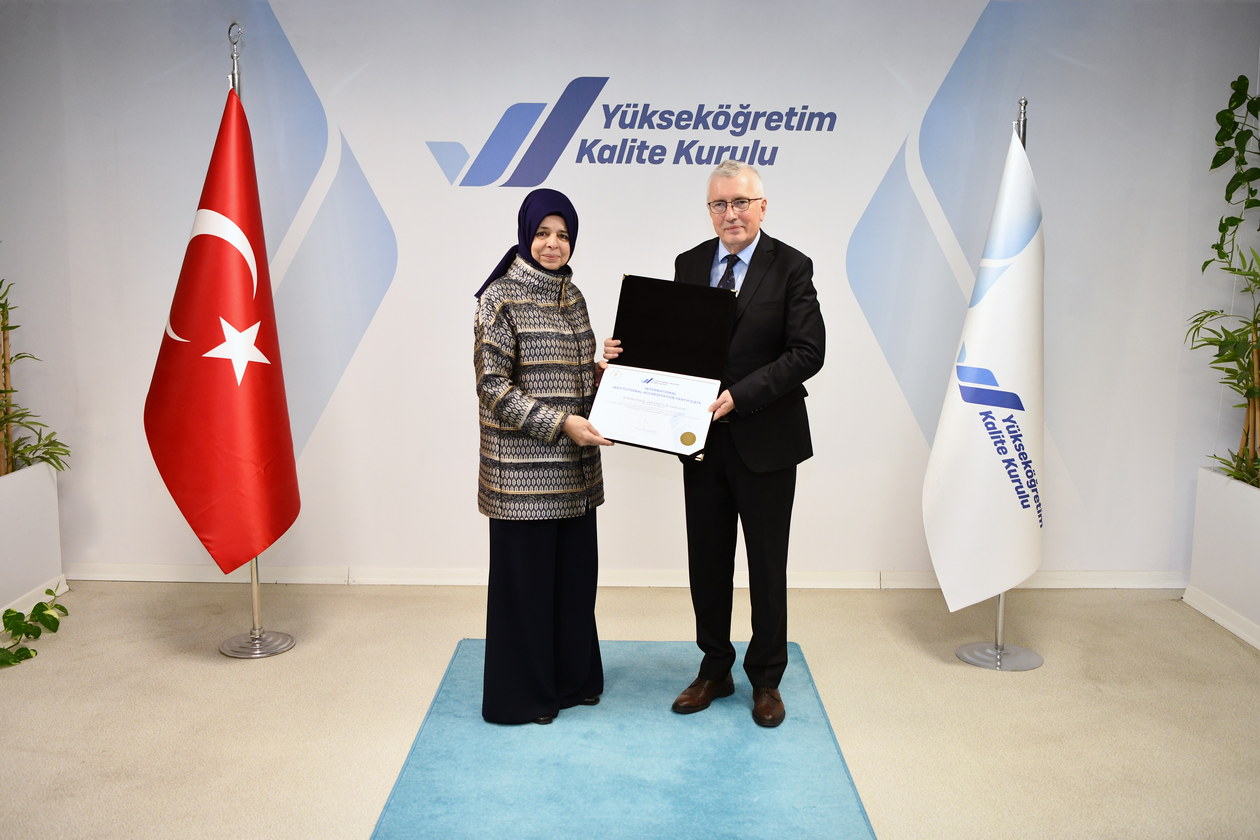
The 5-year International Institutional Accreditation Certificate awarded to IUS was presented to Prof. Sevgi Kurtulmuş, Chair of the IUS Board of Trustees, by Prof. Ümit Kocabıçak, THEQC President.
A First Beyond Borders: IIAP and IUS Success
Initiated by THEQC and recognised by the European Quality Assurance Register for Higher Education (EQAR) and the European Association for Quality Assurance in Higher Education (ENQA), the IIAP was implemented in 2025 as the first cross-border external evaluation program targeting HEIs outside of Türkiye. IUS, the first participant of the program, achieved this success following a comprehensive site visit conducted on 15-18 December 2025, with its compliance with quality standards officially registered.
In addition to being the first foundation HEI in Bosnia and Herzegovina, IUS constitutes one of the most important pillars of the educational bridge between the two countries with its 21 double-degree programs conducted with Turkish universities. The accreditation decision proves that the education offered by IUS is fully compliant with the Standards and Guidelines for Quality Assurance in the European Higher Education Area (ESG) and that the university has internalised a culture of continuous improvement.
‘Soft Power’ and Science Diplomacy in Higher Education
Evaluating the decision, President Kocabıçak emphasised that IIAP is a strategic ‘soft power’ instrument for global outreach aligned with Türkiye’s educational policies and CoHE’s “Roadmap for Turkish Higher Education Towards 2030” action plan. He added, “THEQC aims to increase the global competitiveness of HEIs, especially within our shared historical and cultural geography, by carrying our national-level quality assurance experience beyond borders. This accreditation received by IUS is an indicator of the international validity and reliability of the Turkish higher education model, as well as the success of the university.”
A First in the European Database
The accreditation report of the IUS also holds the distinction of being one of the first institutional accreditation reports to be published in the Database of External Quality Assurance Results (DEQAR) among all HEIs in Bosnia and Herzegovina. Thus, it aims to directly contribute to the international recognition and mobility of the university’s graduates.
While THEQC continues to disseminate the quality assurance culture through IIAP, it also continues to evaluate the intense accreditation demands coming from different regions, particularly the Balkans.
About EQAR
EQAR stands for the European Quality Assurance Register for Higher Education. All institutions in the European higher education area are subject to regular external evaluation by quality assurance agencies. The Standards and Guidelines for Quality Assurance in the European Higher Education Area (ESG) constitute the basis for the external evaluation. EQAR is the official register body of quality assurance agencies operating in the European higher education area in full compliance with the ESG.
About ENQA
ENQA is the umbrella organisation responsible for coordinating higher education quality assurance activities across Europe. It contributes to its members and stakeholders by promoting European cooperation in the field of quality assurance in higher education and disseminating its knowledge and expertise among them to develop and share good practices and improve the European quality assurance dimension.